
Financial adviser Melbourne · Guide
Top 5 Financial Adviser In Melbourne: How To Choose The Right One
These are the top 5 ways to choose a financial adviser in Melbourne. They are also the five things the top financial advisers in Melbourne have in common. This isn't a ranking of firms. The best financial adviser in Melbourne for you is the registered, properly licensed adviser whose experience, fees and way of working fit the decisions you actually need to make. A retiree weighing up the Age Pension, a business owner preparing to sell and a UK expat with a British pension need very different expertise, even from advisers who list the same services. Use the five checks below to compare any financial adviser in Melbourne. Then use the red flags, questions and cost guide to make your choice. At the end, we hold AMGENT up against the same five checks so you can judge us on the same terms.

1. Choose a financial adviser in Melbourne who is registered, qualified and easy to check
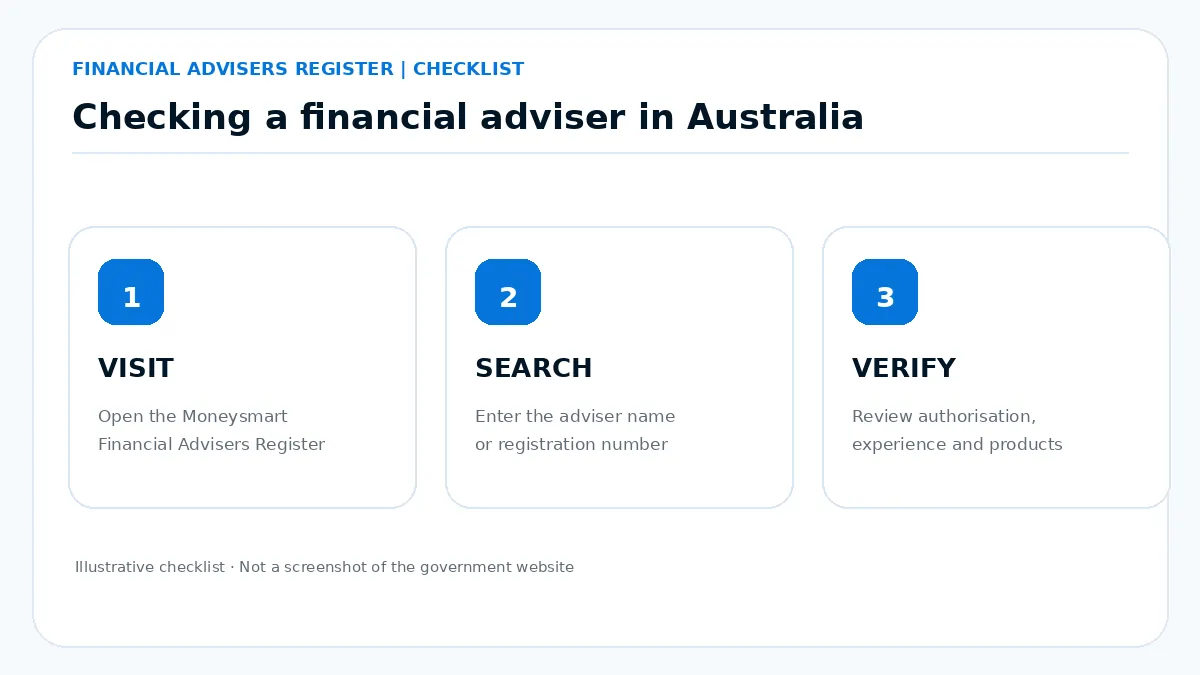
In Australia, only registered "relevant providers" can call themselves a financial adviser or financial planner and give personal advice on investments, super and life insurance. They must meet national education standards, pass the financial adviser exam, complete continuing professional development each year and follow a legislated Code of Ethics. To check an adviser:
- Go to the Financial Advisers Register on Moneysmart.
- Search their name, adviser number or suburb.
- Confirm they are current, and note their licensee (AFSL) and the products they are authorised to advise on.
- Review their qualifications, memberships and employment history.
Higher designations such as the CFP® (Certified Financial Planner®) show additional study, experience and ethics requirements beyond the legal minimum.
2. Make sure they are properly licensed and open about conflicts
Every adviser either holds an Australian Financial Services Licence (AFSL) or is authorised by a licensee. Their Financial Services Guide must explain who they are, what they can advise on, how they are paid, any links to product providers and how to complain, including access to the Australian Financial Complaints Authority (AFCA).
Pay attention to the word "independent". Under section 923A of the Corporations Act 2001, an adviser can only use it if they meet strict conditions, including receiving no commissions or other conflicted remuneration. Many good advisers don't meet that test and must say so in their FSG. Every adviser must act in your best interests when giving personal advice. The best ones explain their conflicts plainly instead of hoping you won't ask.
3. Insist on transparent fees in writing
You should know the scope of work and the total dollar cost before any personal advice begins. A good financial adviser explains:
- the initial advice fee to prepare and present a Statement of Advice (SOA)
- whether ongoing advice is recommended, what it includes, and that ongoing fee arrangements must be renewed by you each year
- any product, platform or implementation costs on top
- any commissions, such as on life insurance
Moneysmart's guide to financial advice costs is a useful benchmark. The cost section below shows real fee ranges.
4. Match their experience to your situation
Years of experience matter less than experience with problems like yours. Ask for examples of similar situations they have handled:
- Retirement and the Age Pension: see what good retirement planning in Melbourne covers
- Business sale or succession: see financial advice for business owners
- UK pensions and cross-border issues: see UK expat financial advice
- SMSFs and large super balances: see superannuation and SMSF advice
- Medical and high-income professionals: see advice for medical professionals
A good adviser will also tell you when your question falls outside their expertise and refer you on.
5. Look for a clear advice process and genuine ongoing service
Look for a defined process: discovery, agreed scope and fees, personal recommendations, implementation and review. Ask who will look after you over time, how often reviews happen and what triggers a change to your plan. One-off advice may be enough for a single, contained decision. Ongoing advice should earn its fee with real reviews and decisions, not just an annual report.
Boutique, bank-aligned, super fund or large firm: which type of financial adviser suits you?
| Adviser type | Typically suits | Questions to ask |
|---|---|---|
| Boutique or principal-led practice | People who want direct senior access, continuity and coordinated advice on connected decisions | Who covers for the adviser when they are away? What capacity do they have? |
| Large or national advice firm | People who value scale, in-house specialists and broad resources | Will I keep the same adviser? How is my service tier defined? |
| Bank-aligned or product-issuer-aligned adviser | People comfortable with a narrower product menu | What products can you recommend? What links exist to the owner's products? |
| Super fund adviser | Members with simple questions about their own fund, often included in membership or at low cost | Is the advice limited to this fund? What isn't covered? |
There is no "best" type. The right one depends on how complex your situation is and how much continuity you want. Read more about what working with a boutique financial adviser in Melbourne involves.
Why "best financial adviser in Melbourne" lists can mislead
Search "best financial adviser Melbourne", "best financial planner Melbourne" or "top financial advisers Melbourne" (or use the US spelling, "advisor") and most of page one is directories, "top 10" lists and review sites. They can be useful starting points, but it helps to know what they measure:
- Reviews measure the service experience, not advice quality. A friendly, responsive adviser can earn five stars. Whether the strategy was right may not be known for years.
- Some lists are paid placements. Several "best adviser" directories disclose that advisers pay a listing fee to appear, even where entry criteria also apply. Read each site's "how we rank" or disclosure section.
- Rankings often reflect distance and review volume. Large firms and super fund advisers with many clients naturally collect more reviews.
- The official register doesn't rank anyone. Moneysmart notes that Financial Advisers Register search results are randomised and in no particular order.
Use reviews to build a shortlist, then apply the top 5 checks.
Red flags when comparing financial advisers
- Products are recommended before your goals and circumstances are understood
- Returns, tax savings or outcomes are presented as guaranteed
- They won't give you an FSG or can't clearly explain how they are paid
- Fees are only quoted as a percentage, with no dollar figure
- There is pressure to sign ongoing services or act quickly
- They aren't on the Financial Advisers Register, or the details don't match
- Nobody can tell you who stays responsible for your plan when circumstances change
Questions to ask before you choose
- Are you on the Financial Advisers Register, and who is your licensee?
- Can I see your current Financial Services Guide?
- What experience do you have with situations like mine?
- What exactly is included in the advice, and what is excluded?
- What is the total dollar cost, including any product costs or commissions?
- Will I deal with you personally over time?
- How do you work with my accountant and lawyer?
- If you recommend ongoing advice, what will I receive each year, and how do I end it?
Moneysmart notes that advisers don't usually charge for the first meeting, so meeting two or three gives you a real comparison.
How much does a financial adviser in Melbourne cost?
Costs depend on the scope and complexity of the work, so be wary of anyone who quotes before understanding your situation. As one transparent example, AMGENT's current Financial Services Guide (Version 02.26, issued 1 July 2026) lists these ranges, including GST:
- Initial advice: $3,500 to $22,000
- Ongoing advice: up to 1.1% of funds under management, ranging from $5,500 to $55,500 a year, indexed to CPI
- Hourly work: $330 to $550 an hour
Compare quotes on what you receive for the fee, not the headline number alone. Our article Is a Financial Adviser Worth It in Australia? explains how to judge value.
Financial adviser Melbourne: local considerations

- Location vs fit. A nearby office is convenient, but most advice work can be done by video. Prioritise fit and expertise, and confirm whether face-to-face meetings are available if they matter to you.
- Ask your accountant or lawyer. Advisers who already coordinate with other professionals are often the ones those professionals refer to.
- Melbourne-specific decisions. Downsizing a family home, Victorian stamp duty concessions for pensioners, business sales and inner-city property all raise questions a local adviser will know well.
- Suburb guides. If you live in Melbourne's north-east, our guide to choosing a financial adviser in Ivanhoe covers the same checks locally.
How AMGENT measures up against the top 5

We don't claim to be the best financial adviser in Melbourne. Nobody can honestly claim that for every client. Here is how AMGENT compares against the five checks above, so you can decide for yourself.
| Check | AMGENT Wealth Management |
|---|---|
| 1. Registered and qualified | Benjamin (Ben) Waite is Authorised Representative No. 001004141 on the Financial Advisers Register. His qualifications are CFP®, CFTe, Master of Applied Finance, Advanced Diploma of Financial Planning and Diploma of Technical Analysis, and he is a qualified tax relevant provider (QTRP). He has 25+ years across financial markets, superannuation and financial advice. |
| 2. Licensed and open about conflicts | AMGENT Wealth Management Pty Ltd is Corporate Authorised Representative No. 001318113 of Spark Advisors Australia Pty Ltd (AFSL 380552). The FSG states AMGENT can't describe itself as independent, because commissions may be received on some life insurance products. |
| 3. Transparent fees | Fee ranges are published in the FSG, and scope and fees are agreed in writing before personal advice begins. |
| 4. Matching experience | Business owners, UK expats, professionals and medical professionals, pre-retirees and retirees. Advice covers wealth, retirement, super and SMSF, insurance, TPD claims, and estate and succession. |
| 5. Process and ongoing service | A five-step advice process, direct senior adviser access and coordination with your accountant and lawyer. |
If AMGENT isn't the right fit for your situation, we'll tell you in the first conversation. Learn more about AMGENT as a financial adviser in Melbourne or meet Ben.
FAQs: choosing the best financial adviser in Melbourne
Who is the best financial adviser in Melbourne?
There is no single best adviser for everyone. The best adviser for you is registered on the Financial Advisers Register, properly licensed, transparent about fees and conflicts, and experienced with situations like yours. Meet two or three before you decide.
How do I check if a financial adviser is legitimate in Australia?
Search their name or number on the Financial Advisers Register at moneysmart.gov.au. Confirm they are current, check their licensee and authorisations, and read their Financial Services Guide.
Are online adviser ratings and "top 10" lists reliable?
They can help you build a shortlist, but reviews mainly reflect the service experience, and some directories disclose that advisers pay to be listed. Always check the register and the FSG yourself.
Is an independent or fee-only adviser always better?
Not necessarily. "Independent" is a restricted term under section 923A of the Corporations Act. Advisers who meet it have fewer conflicts, but all advisers must act in your best interests. Compare experience, fees and service as well as remuneration.
How much does a financial adviser cost in Melbourne?
It depends on the scope. As an example, AMGENT's current FSG lists initial advice fees of $3,500 to $22,000 and ongoing advice of up to 1.1% of funds under management ($5,500 to $55,500 a year), including GST.
What qualifications should a good financial adviser have?
Every registered adviser must meet national education and exam standards and complete annual professional development. Designations such as CFP® show additional study and experience.
Should I choose a financial adviser close to where I live?
Location is convenient but less important than fit. Many advisers, including AMGENT, offer video meetings. Confirm face-to-face availability if it matters to you.
How many financial advisers should I meet before choosing?
Two or three is usually enough to compare approach, fees and rapport. First meetings are often free.
Is AMGENT an independent financial adviser?
No. AMGENT's Financial Services Guide states that the firm and its adviser can't describe themselves as independent, impartial or unbiased, because commissions may be received on some life insurance products.
Does AMGENT offer a free first meeting?
Yes. AMGENT offers a free, no-obligation 30-minute discovery conversation with Ben, at the Collingwood office or by video.
Talk to a financial adviser in Melbourne about your situation
Finding the best financial adviser in Melbourne starts with being clear about the decision in front of you, then applying the top 5 checks above. That decision might be a retirement date, a business sale, a UK pension or a portfolio that no longer makes sense. Bring it to a free 30-minute conversation with a financial adviser in Melbourne, and use it to test us against the checklist.
Email info@amgentwealth.com.au · 88 Langridge Street, Collingwood VIC 3066